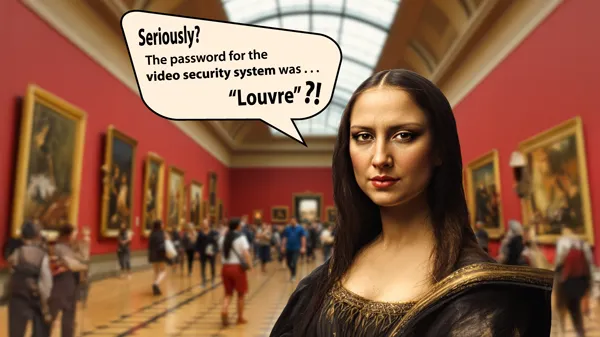
The Louvre's Vulnerable Legacy System Password
What a gem heist tells us about enterprise authentication risk
On October 18, 2025, thieves brazenly stole the French Crown Jewels from the Louvre Museum — and in the aftermath, one detail stood out as shockingly illustrative of a broader cyber-risk: the password for the museum’s video surveillance system was simply “Louvre.”
Yes, the world’s most famous museum guarding irreplaceable national treasures and a critical security system protected by a stupid password so literal it beggars belief. Beyond the optics, this story delivers a clear message to every enterprise CIO, CISO, and infrastructure leader: even legacy systems in prestige institutions can harbour risky, trivial credentials, and that puts every organization at risk.
Passwords: Not just a user-problem
It would be easy to dismiss this as a museum outlier — “they must have been behind the times.” Yet the data say otherwise.
Roughly 78% of individuals reuse the same password across multiple accounts — and 52 % use it on three or more.
Studies show 80% of security breaches involve phishing or compromised login credentials.
The root problem: human behavior. Re-using, sharing, or choosing predictable passwords isn’t a tech problem, it’s a people + process problem — which means any policy relying on humans to “be perfect” is flawed. If the Louvre can run a video-surveillance server protected by “Louvre,” your enterprise is likely just one audit away from a similar weak link.
Legacy systems amplify the threat
What makes the Louvre example even worse is how deep the rot goes: audits going back to 2014 flagged “trivial” passwords and outdated infrastructure (including unsupported OS/hardware). For enterprise environments, legacy systems and forgotten services often become the breeding ground for these weak credentials. They’re rarely covered by the latest MFA roll-outs or identity governance programs.
It's time to ask a new question
It’s no longer sufficient to ask “Are our passwords strong enough?” Instead ask: “Why are we still relying on passwords at all?” Because when the weakest link is a word a human chose – and can reuse, share or type wrong – you’re offering attackers a predictable entry point.
At Password Free, our message is clear: removing passwords entirely, even for legacy systems, isn’t a “nice-to-have,” it’s a necessity. We help organizations replace password-based access across desktops, cloud apps, VPNs and on-prem systems. Because when the world’s most famous museum can’t enforce strong password hygiene, what hope do ordinary companies have?
For more information, read about the museum’s post-heist security report in PC Gamer and the original reporting in Libération (paywall).